Saturday, November 19, 2011

The End of the Big Bang Theory

The End of the Big Bang Theory:
Most of us familiar with thestandard big bang theory we learned in middle or high school. Whatmany of us don't know, however, is that the theory many of us learnedhas been modified greatly in the past two decades, and may even beshortly obsolete. An exciting new theory – the cyclic model –based on M-theory has also been proposed, and might eventuallyreplace the big bang theory as the most viable explanation for theuniverse we inhabit. I'm going to attempt to explain the basics ofthe cyclic model in plain, non-mathematical language because,frankly, I'm extremely excited by it – and I hope you will be too.But first, I'm going to try to explain the big bang theory we alllearned is in trouble, and how physics got to where it is right now.

None of the following, naturally, is myown creation, but is a rather a review of scientific work done byastrophysicist Paul J. Steinhard at Princeton Univerity andtheoretical physicist Neil Turok at Cambridge University. Theintroduction here is based on common knowledge in cosmology andquantum physics.

A model of the big bang with inflation added.
What's wrong with big bang theory?

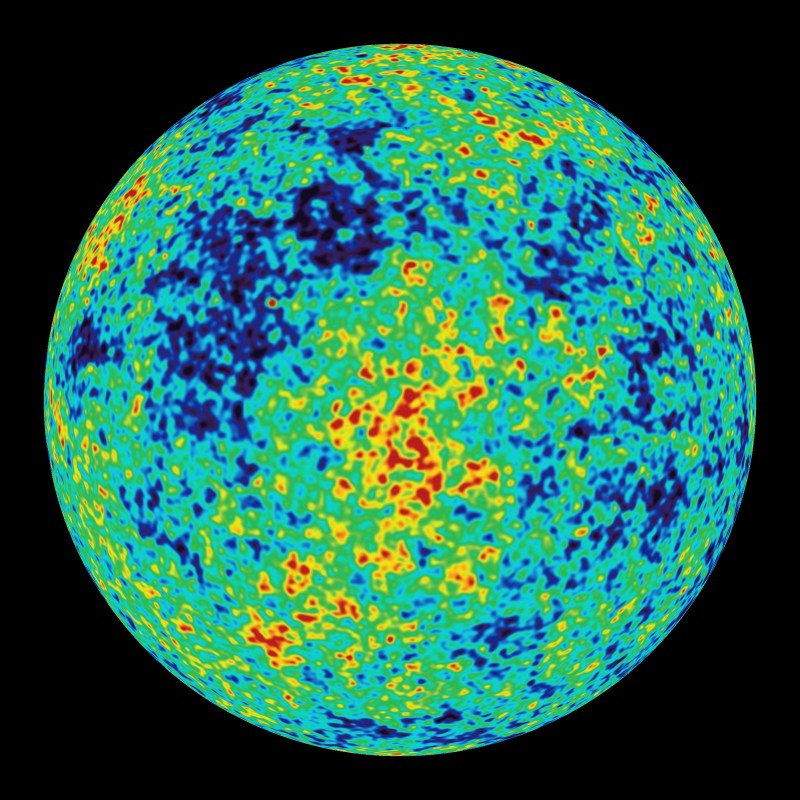
If you've heard of the bigbang theory, you've probably heard an explanation that goes something like this: about 14 billion yearsago, the universe was 'compressed' into an infinitely hot and densepoint of plasma energy. That point – which is properly called a'singularity' – expanded or exploded outward, and over time theenergy cooled into subatomic particles, atoms, and elements, andeventually formed stars and galaxies, in other words, matter. That'sthe basic idea, and it's probably how the theory is explained tolaypersons and elementary school students around the world. But very early on, physicists realizedthere were a lot of problems with this theory. For a start, there'sthe issue of gravity: that much compressed energy would have amassive gravitational pull (you may remember from school that massand gravity are related in that the more massive an object is, thegreater its gravitational pull). What would cause the singularity to'explode' with enough force to overcome that gravity? An early answerwas that under certain circumstances gravity can actually becomerepulsive, and this is certainly theoretically possible. But once thesingularity had expanded, why didn't all the plasma collapse back inon itself from its own gravitational pull? Cosmologists had to add anadditional force to make the expansion of the universe stronger thanthe attraction of gravity – and thus, the inflationary bigbang theory was born. Inflation posits that some repulsive force, thecurrent contender being a mysterious force called dark energy, butdon't worry about that right now – caused the universe to expand ata mind-bogglingly rapid rate, doubling its size 100,000 times in atrillionth of a second or so. After this incredibly short period ofinflation, the “inflaton field” driving expansion turned off, andthe universal expansion slowed considerably (it still continues todouble in size every 10 billion years or so). Hubble's observationthat galaxies are moving away from us at an accelerating rate certainsupports the early expansion of the universe, and both the big bangtheory and the inflationary model were confirmed by mapping thecosmic background radiation in 2001 (a tremendous success of NASA'sWAMP satellite).


Play video of WMAP visualization
This image from the WAMP satellite
shows the cosmic microwave background
radiation and confirms the big bang.
Unified Fields and Unified Theories

The greater issue with the big bangmodel, even when inflation is included, requires a tiny bit of easyto understand background in relativity and quantum theory. Onceagain, we all know that “relativity” is Albert Einstein'srevolutionary theory, mathematically expressed as e = mc2.One of many of the theory's contributions to science is that itallowed us to understand time and space as deeply inter-related, andit led to the 'unification' of three of the four fundamental forcesof nature. (The four fundamental forces are: electromagnetism, whichincludes radiated energy like light, x-rays, radio waves, and so on,the strong force and the weak force, two forces that are importantfor atomic nuclei and electrons and about which we need not be tooconcerned here, and gravity.) Relativity theory demonstrated thatthree of the four forces – electromagnetism, strong force, and weakforce – are three different expressions of one “unified field.”Think of it this way – just as water is neither liquid or solid butgas above its boiling point, all three forces are in one form ofenergy at a very, very high temperature. Physicists concluded,therefore, that all four forces, and all of the particles inthe universe (protons, neutrons, and subatomic particles) must beproducts of this one unified field, and decades of research have beenspent trying to find this one “Grand Unified Theory” that containall four forces and explains basically everything we know about theuniverse (which is why they're often also called “theories ofeverything.”) A field like this must have existed when the universewas in that hot, dense state at the beginning – when everything wasin the form of undifferentiated plasma energy. But trying to piecetogether what happened 14 billion years after the fact based on puretheory and a few observations is basically like showing up to a playafter it's over and being asked to describe the entire story fromstart to finish. You can see the props, the stage setting, perhapseven a few costumes, but that's all. It's incredibly hard, and what'sworse is that when you try to describe the singularity usingEinstein's equations they fall apart completely. Every attemptto describe the first second of the universe, prior to the expansion,using standard relativistic physics produces nonsensical infiniteresults – and in physics, infinite solutions indicate your math hasfailed utterly. The same result occurs when one attempts to 'unify'gravity with the other three forces. The reason is that – you'll besurprised to know – gravity is the weakest of all four forces, andits action so negligible on smaller scales that it just can't be madecompatible with the other forces. Relativity is amazingly good atexplaining and predicting things on massive scales – the curvatureof space, the movement of galaxies, and so on. But when things getreally, really small, relativity theory becomes virtually useless.

The Quantum Enigma

Fortunately, at around the same timethat Einstein was developing relativity theory another revolution wastaking place in physics – the quantum revolution. Quantum physicsarose mainly out of the curious discovery that light seems to be botha particle and a wave (specifically, it had its start as a means ofexplaining why heated objects like metal 'glow' in different colors).This is a fascinating subject but far too extensive for this space.Suffice it to say that in the pursuit of explaining the“particle-wave duality” of light, and with the discovery ofparticles smaller than atoms (like quarks, gluons, bosons, and soon), a whole new theory of particles and forces emerged. Quantumtheory also quickly unified three of the four forces, and becamewildly successful at explaining the mechanics of the universe on asubatomic scale. Almost every technological innovation in the past 75years – from microwaves to microchips – comes to us courtesy ofquantum theory. In terms of usefulness to humankind, quantum theoryhas no peer. But Einstein was thoroughly suspicious of quantum theorybecause, unlike standard relativity theory, quantum theory neverproduces discrete mathematical results – only probabilities.Quantum theory completely turns our view of the universe on its head,challenging our expectations of what can be known and how it can beknown.

Remember Schrodinger's cat, who is bothalive and dead until its owner opens the box? This is a humorousexample of an accepted fact of quantum theory: any particle, a photonfor example (which is light in particle form), never exists in onelocation or state until it observed. In fact, what's been found isthat the particle exists in ALL locations with differentprobabilities until it is observed. Think about that on a macroscale: it is like saying that the tree not only doesn't make a soundin the forest unless someone hears it, it doesn't even existdefinitely in one location untilsomeone sees it! Einstein was appalled, and he insisted that “Goddoesn't play dice with the universe.” He was adamant that“the moon exists even when I'm not looking it.” And so he spentthe rest of his life pursuing a unified field theory based onrelativity, refusing to incorporate what he called the “spookyeffects” of quantum theory, while the rest of the physics communitymoved on (with some considering him to have become a crank). It was arather unfortunate way to end an otherwise spectacular career.

Strings and Extra Dimensions

The inflationary model of the big bangtheory did incorporate quantum theory, it was in fact based upon it,and for that reason most physicists believe it's the best explanationfor the universe that we have. But the problem of unifying the forcesremains. Just as relativity works on grand scales but not on smallones, quantum theory is unquestionably successful for the micro worldbut useless for the macro. Physicists worked for years to unify thefour forces using quantum theory and all sorts of interestingproposals (like supergravity) were made, but none met the criteria ofbeing mathematically sound and verifiable through observation. Then,in the 1970s, a strange new idea called string theory begin toattract notice.

In a nutshell, string theory solves theproblem of unification by stating that the four forces and all theparticles of the universe are actually products of tiny,one-dimensional strings. These strings resonate like a plucked violinor a guitar string, and different resonating frequencies producedifferent particles and forces. Though the idea was slow to catch on,by the 1980s most theoretical physicists were excited about stringtheory and optimistically believed it was the much sought theory ofeverything. But no one knew exactly how to express the theorymathematically, and five different versions of string theory emerged.These five versions were ultimately shown to be just five extensionson one theory, and that became known as the master or m-Theory. (Soif you hear anyone speaking of string theory, you can have yourSheldon Cooper moment and point out that the proper term is“m-theory” now.)

Presently, enthusiasm for string theoryhas waned, and for good reason. First – bear with me on this –consider the physics we're accustomed to using or seeing in ordinarylife. This physics works in four dimensions: length, width, height,and time. Any point in space can be expressed this way. For example,in order to have your friend meet you for coffee at Dunkin' Donuts onMain Street and Jefferson Avenue, you need a longitudinal andlatitudinal position on a map (length and width), a height orelevation (the first floor), and a time. But in order for stringtheory to unite the four forces, space requires six additionaldimensions. That's kind of a problem since no one has ever observedany additional spatial dimensions. The accepted explanation is thatthese dimensions must be so small that they're unobservable. Thatword should single alarm, because science is (according to some, butnot all), grounded in observation. If it cannot be seen or at leastmeasured, it's not scientific – like theories of gods or souls oran afterlife, for example. Some theoretical physicists are happysaying that if the math is sound, empirical measurements are notnecessary. And in fact, without astounding innovations in physics theextra dimensions and the strings themselves in string theory willnever be seen. The energy required to create a reaction that wouldmake them visible or measurable is greater than the entire energyoutput of our sun over its entire lifespan. It's not going to happenany time soon, if ever.

But for those are happy with goodformulas, there's one last issue that might be the death knell forthe big bang theory even with m-theory added. The issue has to dowith 'fine tuning,' an expression that indicates an initial conditionwith seemingly arbitrary fixed values that work favorably for theuniverse. Let me explain. The extra dimensions I just talked aboutwould be very, very small because they would be “curled up,” orfolded, into different formations. The curled up form of thedimensions would be especially important at the beginning of theuniverse, because how they were curled would have decisive effects onthe way the universe turned out. Some arrangements of the dimensionswould result in a universe without any expansion, and therefore nospace. Some would produce expansion but not enough heterogeneity inthe arrangement of matter to form stars and galaxies. So right now,many physicists are feverishly searching for the arrangement of thecurled up dimensions that would produce the universe in which welive. The problem? There may be billions of possible arrangements, orthere may even be an infinite number. Given the technicalchallenge of figuring out the equations for each arrangement – andwe're talking math that not one single physicist on earth will boastof understanding – it may take centuries to locate an arrangementthat works. And even when it's found, we will have to explain why,out of billions of potential arrangements, the early universe was'fine tuned' to exactly the right arrangement for a universe likeours. Why were the dice loaded to favor a universe that, we mustadmit, turned out to be pretty nifty for human beings?

We're just about ready to talk aboutthe cyclic model of the universe, but first a recap for clarity'ssake. Standard big bang theory is incomplete because it'sindescribable using relativistic physics. Additional information isrequired to explain the universe as we observe it now – thedistribution of matter, the expansion of space, for example – andinflationary cosmology mostly does the trick. Describing the unifiedfield in the singularity is a problem solved by adding m-theory intothe mix, but then finding the arrangement of folded dimensions andexplaining the 'fine tuning' of the early universe becomes a dauntingchallenge. String theory itself is the most promising “theory ofeverything,” but the issue of verifiability and making sense of theintricate mathematics continues to cause concern.

In my next post, we'll tackle cyclictheory and discuss how many of these problems are solved by thisexciting new proposal for the origin of the universe.

Wednesday, November 16, 2011

Harvey Pekar statue campaign on Kickstarter gets Alan Moore's help

Harvey Pekar statue campaign on Kickstarter gets Alan Moore's help:


[Video Link]

Ed "Brain Rot" Piskor says:


Harvey's wife Joyce is spearheading this effort to get a Pekar

memorial created at the Cleveland library
, where he spent most of his

time.


As an incentive for $99 donors, the notoriously aloof Alan Moore has

volunteered to participate in an exclusive web conference to field

whatever questions come his way.


Harvey Pekar statue campaign on Kickstarter


Britain's jobless youth told to work without pay for profitable retailers or lose benefits

Britain's jobless youth told to work without pay for profitable retailers or lose benefits:


Young unemployed people in the UK are being told to work for up to 30 hours a week in low-skilled retail jobs for big, profitable firms, without any pay and without promise of any job when their "training" period is finished. Workers who refuse this are cut off their "Jobseekers" allowance (how they're supposed to seek a job while working nearly full-time without any pay is a mystery).


Under the government's work experience programme young jobseekers are exempted from national minimum wage laws for up to eight weeks and are being offered placements in Tesco, Poundland, Argos, Sainsbury's and a multitude of other big name businesses.


The Department for Work and Pensions says that if jobseekers "express an interest" in an offer of work experience they must continue to work without pay, after a one-week cooling-off period, or face having their benefits docked.


Young people have told the Guardian that they are doing up to 30 hours a week of unpaid labour and have to be available from 9am to 10pm.


Young jobseekers told to work without pay or lose unemployment benefits


Tuesday, November 15, 2011

Inside Occupy Wall Street Raid: Eyewitnesses Describe Arrests, Beatings As Police Dismantle Camp

Inside Occupy Wall Street Raid: Eyewitnesses Describe Arrests, Beatings As Police Dismantle Camp: Cop2_web

The Democracy Now! team rushed down to Zuccotti Park in the middle of the night to report on the police crackdown on Occupy Wall Street. We were there until the early hours of the morning, witnessing the arrests in the streets in Lower Manhattan and the dismantling of the encampment — and the hauling away protesters’ belongings. “They can’t pull one over our eyes. They can’t put nothing in our eyes that’s going to blind [us to] what’s going on here. And the same goes for all the people who are out there," a protester told Democracy Now! after the police twice pepper-sprayed him in the face. [Rush transcript to come. Check back soon.]

Saturday, November 12, 2011

Iran: Here We Go Again?

Iran: Here We Go Again?:

9 November 2011


Iran: Here We Go Again?


By Gwynne Dyer


“We will not build two (nuclear) bombs in the face of (America’s) 20,000,” said Iranian President Mahmoud Ahmadinejad in response to an International Atomic Energy Agency report this week that accuses Iran of doing just that. He called Yukiya Amano, the head of the IAEA, a US puppet, saying: “This person does not publish a report about America and its allies’ nuclear arsenals.”


Well, that’s true, actually. Amano will never publish a report about America’s nuclear weapons (only 5,133 of them now, actually). He hasn’t said anything about Israel’s, Britain’s and France’s weapons of mass destruction either. And his report is largely based on information fed to him by Western intelligence agencies.


But apart from that, Amano is as impartial and free from US influence as you would expect a career Japanese diplomat to be. Only cynical people will see any resemblance to Colin Powell’s performance at the United Nations in 2003, when the US defense secretary held up a test tube and assured us all that Iraq really was working on germ warfare.


Iraq was allegedly working on nuclear weapons, too: former President George Bush’s famous “smoking gun,” which also subsequently went missing. And on the basis of this “intelligence” about Iraq’s “weapons of mass destruction,” the United States and its more gullible allies invaded the country. Hundreds of thousands died, no weapons were found, and nothing was learned. Here we go again.


Fool me once, shame on you. Fool me twice, shame on me. The same intelligence agencies are producing the same sort of reports about Iran that we heard eight years ago about Iraq’s nuclear ambitions, and interpreting the information in the same highly prejudiced way.


Many people in the West realise that they are being hustled into yet another attack on a Middle Eastern country, but they don’t really worry about it too much. After all, it will only be air strikes, and we all know that an air-only war is practically casualty-free for the side with air superiority. Look at Libya, for example.


But how many citizens of the United States or Britain know that Iran has ten times as many people as Libya? Maybe one in ten, maybe one in twenty. How many know that Iran is a partially democratic, technologically proficient state with no history of attacking its neighbours, not a tinpot dictatorship run by a vicious loon? About the same number. How many realise that the war would not end with a few days of air strikes? Practically none.


The interesting exception to all this is Israel, where people do know those things, and where there is a vigorous debate about whether attacking Iran is a good idea. A lot think it is not, and that also goes for both of Israel’s intelligence agencies, Mossad and Shin Bet. Meir Dagan, the recently retired head of Mossad, said last January that an attack on Iran was “the stupidest idea” he had ever heard.


So Israeli Prime Minister Binyamin Netanyahu and Defence Minister Ehud Barak, who do both want to attack Iran (or rather, have the United States do it for them), have gone public. If the Western powers don’t act at once, they warn, then Iran will get nuclear weapons and Armageddon will be just around the corner.


There are two things wrong with this proposition. One is the evidence. If you believe it all, it shows that Iran wants the knowledge and equipment that would let it build a nuclear weapon very quickly if necessary: an Israeli nuclear threat, a military coup in nuclear-armed Pakistan that brings young Shia-hating officers to power, whatever.


The evidence does NOT show that Iran is actually building a nuclear weapon now, or has any present intention of doing so. And having the knowledge and equipment that would let you do so fast in an emergency is entirely legal under IAEA rules.


The other problem with the accusations against Iran is the logic behind them. Building a nuclear weapon now would be extremely costly for Iran in terms of economic sanctions, global diplomatic isolation and the like if it became known. But it would be completely pointless from a deterrence point of view if it remained secret.


Deterrence is the only logical reason that Iran would ever want nuclear weapons, since it would be suicidal for it to attack anybody with them. As Mahmoud Ahmadnejadi pointed out (above), it would have at the most a few nuclear warheads. The United States has thousands of them, Israel has hundreds of them, and even Pakistan has dozens.


If Iran’s leaders were completely logical in their thinking, they wouldn’t waste a minute thinking about nuclear deterrence. They’d just rely on the fact that their military can completely shut the Gulf to oil traffic and bring the global economy to its knees if anybody attacks them. However, they are still a lot more rational than their Western counterparts – or at least than their Western counterparts can afford to seem in public.


You heard about that recent exchange between French President Nicolas Sarkozy and US President Barack Obama that went out on an open microphone? Sarko said “I can’t stand (Netanyahu) any more. He’s a liar.” And Obama replied: “YOU’RE sick of him? I have to deal with him every day.” What about? One gets you ten that it’s about bombing Iran.


_______________________________


To shorten to 725 words, omit paragraphs 3, 6 and 13. (“But apart…warfare”; “Many…example”; and “Deterrence…dozens”)

Morrissey sells out: Smiths’ track covered for Christmas advert

Morrissey sells out: Smiths’ track covered for Christmas advert:

image


Morrissey has allowed high-street department store, John Lewis to use a cover version of “Please, Please, Please, Let Me Get What I Want” on the chain’s £6 million Christmas advertising campaign. The track has been covered by Slow Moving Millie (aka Amelia Warner, ex-wife of Colin Farrell, apparently), which follows on from last year’s take of Elton John’s “Your Song” recorded by Ellie Goulding.


According to the Daily Telegraph Morrissey is “delighted” that the chain was using the track. Craig Inglis, John Lewis’s marketing director, is quoted as saying:


“We know our audience holds The Smiths and bands from that era in high esteem.”


“It’s a magical feeling when you find that perfect present for someone; there’s a great sense of anticipation from the moment you buy it to the moment you give the gift on the big day.


“That feeling is exactly what we’ve tried to capture with this year’s Christmas campaign.”


Ruth Paterson, head of marketing at Rough Trade, the record label which released most of The Smiths’ work, said she was entertained by the collaboration.


“I do like the idea of a really good song by a really good band being played in Middle England’s living rooms,” she told The Times.


“I’m sure that wasn’t the song’s intended purpose, but I think that’s a good thing.”


As Morrissey edges towards a pensionable age, the “substantial pecuniary boost” this ad will bring will no doubt be greatly appreciated - though perhaps not by his fans, as if that will matter.


After Morrissey and Christmas, who’s next? And what other advert involving high street business and alleged hip musician would make for the most unlikely pairing? Suggestions, please.


Jennifer Daniel's art based on Playboy centerfolds who have died

Jennifer Daniel's art based on Playboy centerfolds who have died: Screen Shot 2011-11-11 At 4.38.40 Pm

This is a detail from a print called Dead Sexy by artist Jennifer Daniel. The print reproduces the lips from the centerfold photos of the 36 Playmates of the Month who have died since 1963, listing their causes of death. Lots of suicides and drug overdoses!

Dead Sexy, by Jennifer Daniel